Mindoro and Romblon
Between Luzon and Palawan, Mindoro is home to Apo Reef and the diving of Puerto Galera, while Romblon preserves isolated islands and the marble of colonial workshops.
Mindoro is the seventh-largest island in the archipelago, three hours by ferry from Batangas, south of Manila. The island is divided into two provinces: Mindoro Oriental to the east, with its capital Calapan, and Mindoro Occidental to the west, more rural, whose coast opens onto the Sulu Sea. At the centre, the Halcon mountain range peaks at 2,586 metres and remains one of the least-travelled massifs in the country. The high plateaus shelter Mangyan communities, divided into eight ethnolinguistic groups, of which the Hanunoo and Buhid still preserve a pre-colonial syllabic script carved on bamboo.
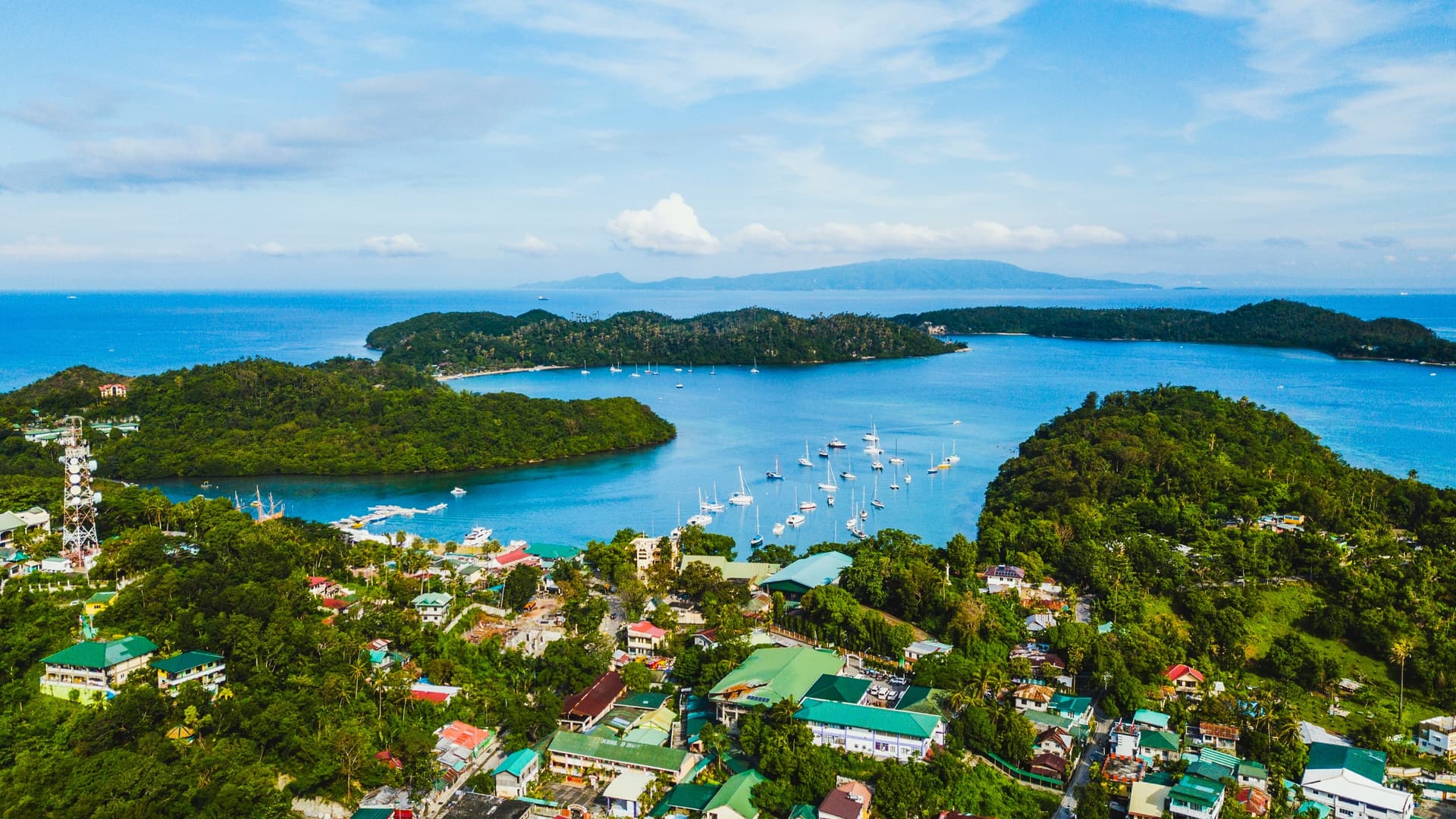
Puerto Galera, on the north coast, concentrates most of Mindoro's tourism activity. The site has been classified as a UNESCO biosphere reserve since 1973, and its Sabang and White Beach bays offer diving that is practically possible year-round thanks to protection from currents. More than forty diving sites are accessible by bangka from the coast, with regular visibility between 15 and 25 metres. The descent of the Tamaraw River and the Tukuran waterfall, an hour's drive inland, complete the beach offer for travellers staying more than three days.
To the west, Sablayan is the departure point for Apo Reef, a 34-square-kilometre coral reef classified as a natural park. It is the second-largest continuous reef system in the world after Australia's Great Barrier Reef, and the only one in the Philippines to offer two- to three-day liveaboard cruises in waters at 28 degrees. The area is strictly regulated: boats anchor at fixed coordinates and the number of divers per day is capped, which maintains the state of the corals and the regular presence of grey sharks and green sea turtles.
Romblon is a separate archipelago, east of Mindoro, composed of three main islands: Tablas, Sibuyan, and Romblon itself. Sibuyan is nicknamed the "Asian Galápagos" by biologists for its rate of plant endemism, linked to its geological isolation: the island has never been connected to a continent. Mount Guiting-Guiting, at 2,058 metres, requires three days of technical climbing and remains one of the country's most demanding treks. Romblon town is known for its marble, quarried since the Spanish colonial era, and its cutting workshops still operate around the San Joseph Cathedral, built in 1726.
Carabao, a small island north of Tablas, preserves white sand beaches accessible only by bangka from Caticlan, the usual departure port for Boracay. Visitor numbers remain marginal, with no resort hotels or jet-skis, just a dozen family-run lodges run by converted fishermen. Local cuisine is built around grilled fish, kinilaw with coconut vinegar, and binakol, a soup of chicken with young coconut milk served mainly during the Biniray festival in Romblon town each second week of January.
The economy of these two regions remains agricultural and fishing-based. Mindoro produces rice, cashew nuts, and calamansi, and the west of the island remains one of the last refuges of the tamaraw, an endemic dwarf buffalo whose population has fallen below 600 individuals. This economic discretion explains why tourism infrastructure remains limited outside Puerto Galera, and it is precisely what attracts travellers who want to complete a Luzon-Palawan itinerary without returning through saturated airports.
Highlights
Liveaboard cruise to Apo Reef from Sablayan. Three days on the world's second-largest continuous reef. Regular visibility beyond 30 metres, frequent encounters with grey reef sharks and green sea turtles on the external slopes.
Diving in Puerto Galera year-round. Forty sites accessible by bangka from Sabang. Protected bays allow diving even during the south-west monsoon months, when the rest of the archipelago becomes difficult.
Trekking Mount Guiting-Guiting on Sibuyan. Three days of technical climbing to 2,058 metres, with a final granite ridge. The island concentrates a rate of plant endemism comparable to the Galápagos.
Meeting Mangyan communities. Guided visit to a Hanunoo village in the hinterland of Mansalay, where pre-colonial syllabic script is still transmitted by carving on bamboo stems.
Marble workshops in Romblon town. Tour of the quarries and cutting shops that have exploited marble since the 18th century. The San Joseph Cathedral of 1726 preserves liturgical furnishings that are entirely local.
When to visit
The best period runs from December to May, with an optimal window between February and April: flat seas, temperatures of 27 to 31 degrees, and rainfall below 50 mm per month. January and February are the driest months and coincide with the Biniray festival in Romblon. From June onwards, the south-west monsoon (habagat) brings heavy rain, especially on the west coast of Mindoro and around Sablayan, with totals exceeding 400 mm in August. Bangka connections to Apo Reef and Carabao become unreliable.
Typhoon season runs from July to November, with a peak in October. Sibuyan, exposed to the east, regularly receives the first fronts, and access to Guiting-Guiting is inadvisable during this period. Puerto Galera, sheltered by the Batangas peninsula and Mindoro's internal relief, remains practicable longer than the rest of the region, making it a useful retreat in September-October when the central Visayas experience depressions.
Practical advice
Allow a minimum of four days for Mindoro alone (Puerto Galera plus an inland getaway), six to seven days to combine with Apo Reef on a liveaboard from Sablayan, and ten days to add Romblon. The simplest access to Mindoro is by fast ferry from Batangas (two hours' drive from Manila, then 1h15 by boat to Sabang or Muelle). Sablayan requires a road transfer of five to six hours from Calapan, or an occasional domestic flight to San Jose. Romblon is reached by ferry from Batangas (10 to 12 hours overnight) or via Tablas by air from Manila.
The region logically connects with Northern Luzon (upstream, via Manila) and with Palawan or the central Visayas downstream, which avoids a return trip to Manila. Accommodation remains simple: family-run guesthouses, beachside ecolodges, two or three upmarket addresses in Puerto Galera. Mindoro and Romblon suit divers, self-sufficient hikers, and contemplative travellers who accept longer journeys in exchange for fewer crowds. Less suited to families with young children outside Puerto Galera, due to lack of nearby medical facilities on the secondary islands.