Loboc
Loboc, in the heart of Bohol, brings together a tropical river cruise, a 17th-century Baroque church on the UNESCO World Heritage list, and a tarsier sanctuary — a key stop on the route to the Chocolate Hills.
Loboc is a small municipality on the island of Bohol, crossed by the river of the same name. It is known for its lively river cruises, its Baroque church listed as a UNESCO World Heritage site, and its forests home to tarsiers. Between nature and Spanish colonial history, Loboc makes for a natural stop on the way to the Chocolate Hills.
Practical information at a glance
Access: approximately 25 km southwest of Tagbilaran, reachable by car, motorcycle or shared van (V-hire) from Tagbilaran terminal.
Recommended duration: half a day to a full day depending on activities chosen.
River cruise: paid entry; buffet meals are included in most packages offered on restaurant boats.
Dress code: appropriate attire required to visit the church (shoulders and knees covered).
What to see
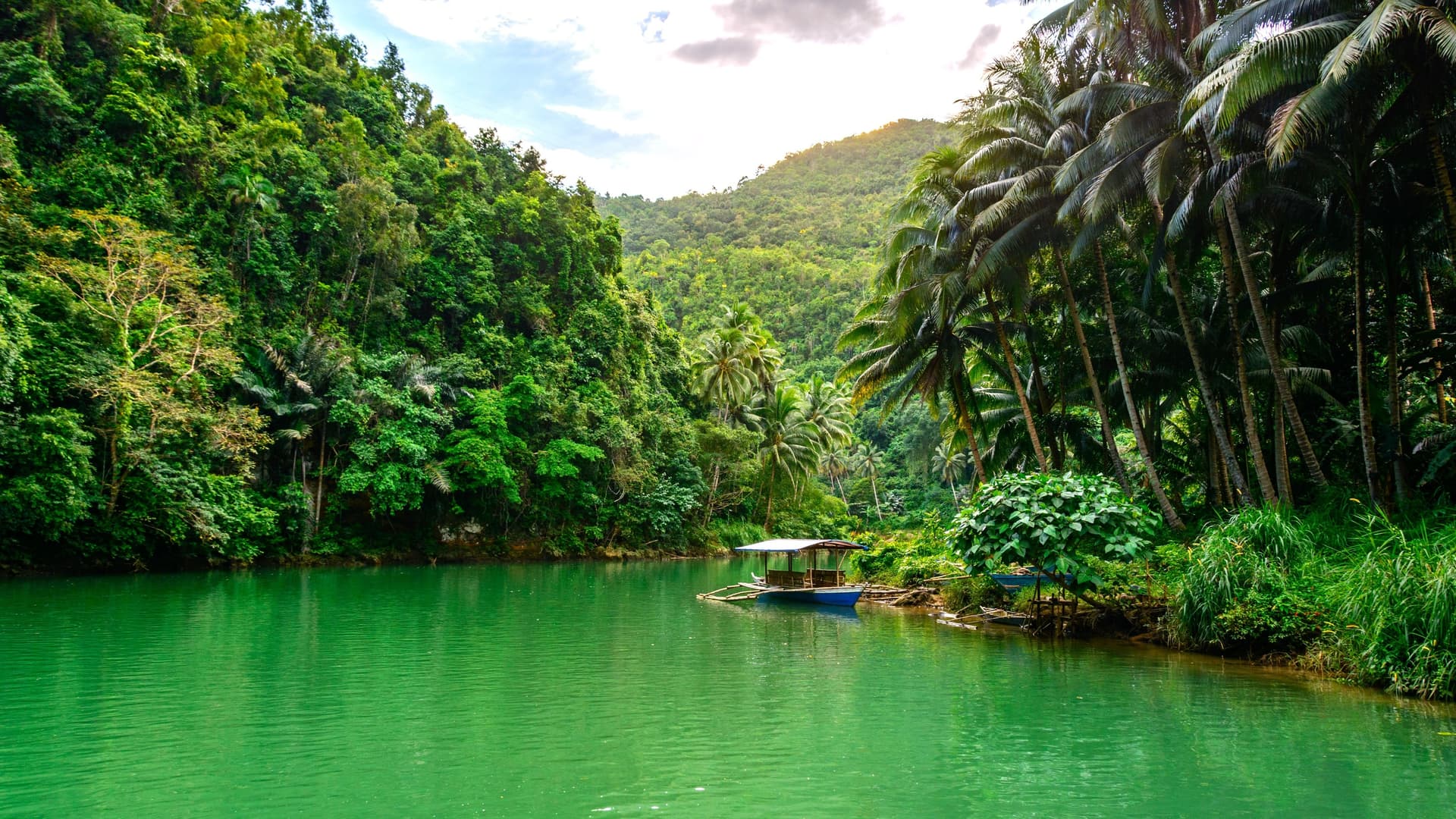
The Loboc River is the heart of the visit. Flat-bottomed boats slowly navigate upstream beneath a dense canopy, while a buffet of local specialties is served on board. Traditional dance groups sometimes perform in riverside villages where the boats stop.
The Church of Saint Peter the Apostle, built in the 17th century by the Augustinians, is one of four Baroque temples in Bohol inscribed on the UNESCO World Heritage list. Its coral stone façade and massive bell tower dominate the central plaza of the town.
History and context
Loboc is one of the oldest Augustinian missions in the Philippines, founded in the 16th century. The present church dates mainly from the 17th century, rebuilt after several fires and earthquakes. The 2013 earthquake damaged the bell tower, which has since been partially restored. The river long served as the main transport route for communities in the interior of Bohol.
Highlights of the visit
The Loboc River cruise
The restaurant boat journey lasts approximately one hour. Tropical vegetation lines both banks, and light filtered by the trees creates a special atmosphere in mid-morning. Stops in villages allow you to observe local dances and purchase handicrafts.
The Church of Saint Peter the Apostle
Listed with three other Baroque churches in Bohol on the UNESCO World Heritage list, it merits careful attention. The interior preserves ancient altarpieces and remarkable acoustics. The Loboc choir, renowned throughout the country, rehearses regularly within the church grounds.
The Loboc Tarsier Sanctuary
A few kilometres from the centre, this forest sanctuary is home to tarsiers in semi-wild conditions. These nocturnal primates, the size of a fist, are endemic to Bohol. Visits proceed in silence along marked trails to avoid stressing the animals.
Etiquette and visiting rules
Shoulders and knees covered to enter the church.
Silence and discretion inside the place of worship, even outside service times.
At the tarsier sanctuary: do not touch the animals, speak in hushed tones, disable flash.
Photography tips
On the river, light is best early in the morning, before the sun gets too high and tree shadows create excessive contrast. For the church, the façade is well-lit late morning facing the square. At the tarsier sanctuary, flash is forbidden; a fast lens or high ISO setting is necessary under forest cover.
Location and access
Loboc is located in the centre of Bohol island, approximately 25 km from Tagbilaran, the provincial capital. The main road connects Tagbilaran to the Chocolate Hills passing through Loboc, making it a natural stop on this route. V-hires (shared vans) run regularly from Tagbilaran terminal. Renting a motorcycle or tricycle allows greater flexibility to reach the scattered sites around town.
Nearby attractions
Chocolate Hills — the famous conical hills of Bohol, approximately 30 km northeast of Loboc.
Corella Tarsier Sanctuary — another tarsier conservation site, managed by the Philippine Tarsier Foundation.
Tagbilaran — capital of Bohol, main entry point by ferry from Cebu.
Baclayon Church — one of the four UNESCO Baroque churches in Bohol, about twenty kilometres from Loboc.
Frequently asked questions
The dry season, from November to May, offers the best conditions for the cruise and outdoor visits. The rainy season (June-October) can make the river more turbid and roads less passable.
Yes, the journey is calm and the boats are stable. The buffet and onboard entertainment are suitable for all ages. Bring a hat and sunscreen for exposed areas.
Yes, this is the classic itinerary from Tagbilaran. The cruise in the morning, the church and tarsier sanctuary at midday, then the Chocolate Hills in the late afternoon for golden light.
No. Flash is strictly prohibited as it stresses and can injure tarsiers, whose eyes are extremely sensitive to light. Set your camera to manual mode with a high ISO.
V-hires (shared vans) depart regularly from Tagbilaran terminal towards Carmen, passing through Loboc. Renting a tricycle or motorcycle offers more flexibility for visiting multiple sites.