Valley of Colors
Valley of Colors
In La Trinidad, near Baguio, over 200 painted houses form the StoBoSa project, a giant mural inspired by Gamcheon and the favelas of Rio.
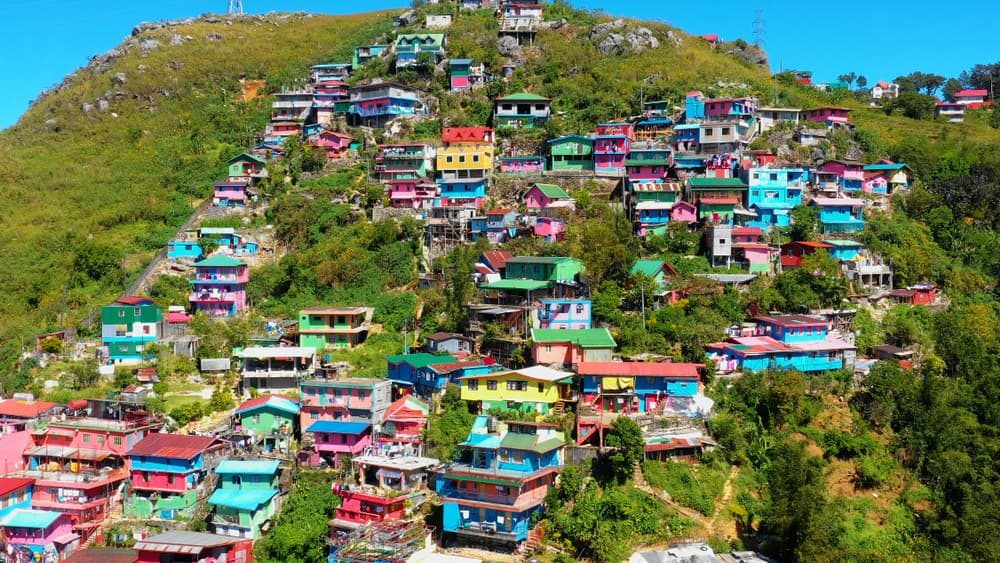
Just a few kilometers from Baguio, on the heights of La Trinidad, the Valley of Colors brings together more than 200 houses painted on a hillside. This community art project, launched in 2016 in the Barangay Balili district, transforms a residential neighborhood into a giant mural visible from the Baguio–La Trinidad–Bontoc road.
Why visit the Valley of Colors
The site, nicknamed StoBoSa, is one of the most accomplished community street art projects in the Philippines. The appeal isn't merely visual: the neighborhood remains inhabited, the murals coexist with the daily life of residents, and the visit unfolds on foot through the alleyways. It's a short and accessible stop from Baguio, which complements a stay well in the Cordilleras region.
Photography enthusiasts will find a palette of vivid tones, with the sunflower—an emblematic flower of the region—as a recurring motif. For travelers interested in local initiatives, the project illustrates how a Philippine municipality mobilized hundreds of volunteers to revitalize a modest neighborhood.
History of the StoBoSa project
The Valley of Colors came to life in 2016 in La Trinidad, in the Barangay Balili district. The project draws direct inspiration from the village of Gamcheon in South Korea and the favelas of Rio de Janeiro, where painting façades was used as leverage for urban and tourist revitalization.
The name StoBoSa is formed from the three zones involved: Stonehill, Botiwtiw and Sadjap. Over 200 houses were painted, with the sunflower as the connecting thread of the murals. The mobilization brought together 520 volunteers—students, scouts, hikers and artists—coordinated by the artistic collective Tam-Awan and the company Davies Paints, with support from the Philippine Department of Tourism.
In 80 days of work, 18,000 m² of façades were covered using 2,800 gallons of paint. In 2018, the filming of several scenes from the Philippine television series Blood Sisters on the site reinforced its national reputation.
What to see on site
The site is organized into three distinct zones that you explore on foot:
- Stonehill: the zone most visible from the road, with the most photographed murals and dominant floral motifs.
- Botiwtiw: a quieter residential sector, where the murals blend into the daily life of the neighborhood.
- Sadjap: the third zone, which completes the StoBoSa ensemble with its own motifs.
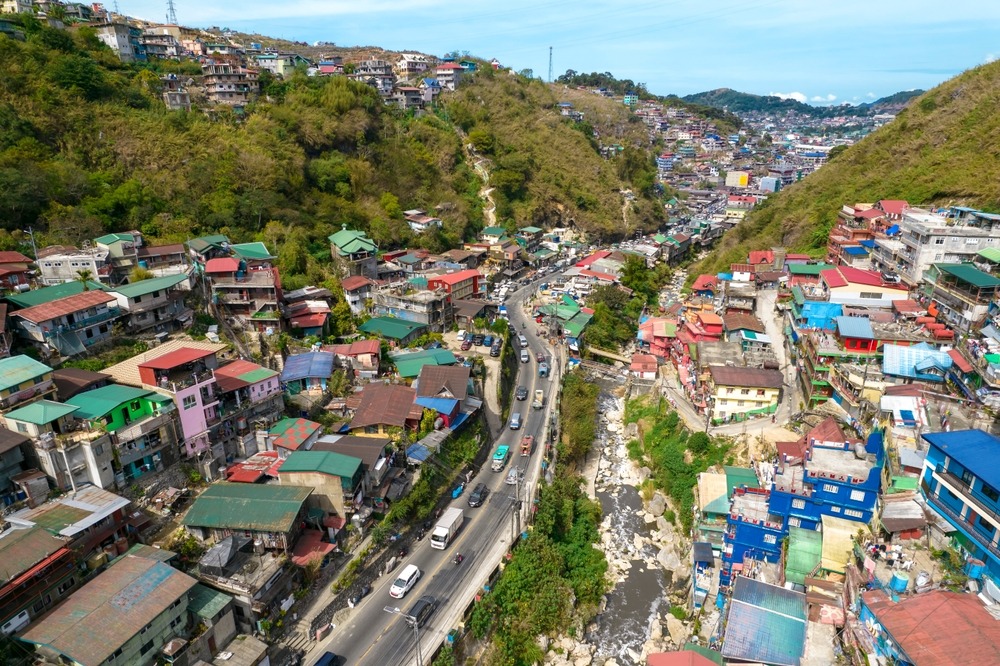
The broadest viewpoint is obtained from the main road, near the Balili River bridge, from where you can take in the entire range of painted hills. To see the murals up close, you must take the alleyways that climb between the houses. Be discreet: the homes are occupied and the neighborhood is not an open-air museum in the strict sense.
Practical information
- Access: free, the site is an open residential neighborhood.
- Fee: free entry. A contribution may occasionally be requested by some residents for access to private viewpoints.
- Duration of visit: plan for about one to two hours to walk the site and photograph the murals.
- Location: Pico barangay, La Trinidad, near the Balili River bridge.
- What to bring: comfortable shoes (the alleyways are steep), water, sun protection.
When to go
Baguio and La Trinidad benefit from a cooler highland climate than the rest of the Philippines. The dry season, from November to May, offers the best visiting conditions: clear skies, well-lit murals, walkable alleyways. The wet season (June to October) brings mist and frequent showers, which can complicate walking in the sloped alleyways and limit visibility from the road.
For light, favor late morning or mid-afternoon, when the sun illuminates the façades frontally.
How to get there
By jeepney from Baguio
From Magsaysay Avenue in Baguio, the La Trinidad jeepney terminal regularly serves the area. Ask for a jeepney heading to La Trinidad / Valley of Colors and indicate your destination to the driver. The journey takes about twenty minutes for a very modest local fare.
By taxi
More comfortable, especially in a group or with photo gear. Count on twenty to thirty minutes from central Baguio depending on traffic, for a reasonable rate on a direct ride.
By car
Enter "Valley of Colors, La Trinidad" in Google Maps or Waze. Follow the Baguio–La Trinidad–Bontoc road to the La Trinidad entrance arch; the site is signposted on the right, shortly after.
What to see nearby
- Bell Church: a Buddhist temple located in immediate proximity, which combines well with the mural visit.
- Baguio's downtown and its markets, about twenty minutes away.
- Further north in the Cordilleras, Bontoc Museum lets you extend your discovery of northern Luzon cultures.
Frequently asked questions
Frequently asked questions
Including the Valley of Colors in a trip
The Valley of Colors naturally fits into a stay in the Baguio and Cordilleras region, complementing more natural or cultural stops. To build a custom itinerary in the Philippines, consult our Philippines trips.
Interested in this visit?
We can include it in your personalised itinerary.